
General Flooded Lead Acid Battery: The lead-acid battery works by using lead and lead(IV) plates submerged in sulfuric acid. The lead(IV) oxidizes the lead plates and creates an electrical current. All current is propelled by an electromotive force, which is measured in volts. Lead-acid batteries have 2.1 nominal volts per cell and six cells connected in series, giving a nominal voltage of 12.6 volts; they can be safely charged at 2.4 volts per cell, for a total charge voltage of 14.4 volts. The lead-acid battery is also the only one of the three that requires maintenance due to off-gassing, which is not environmentally friendly. It is also very heavy — often more than twice the weight of a lithium battery — making it the heaviest of the big three. Its only real advantage is low cost. These batteries also have the shortest expected life, at 2–5 years depending on whether a trickle charger is used.
General AGM Battery: The AGM battery is a sealed lead-acid battery with less electrolyte than a flooded lead-acid battery. Rather than being flooded in electrolyte solution, the electrolyte is held in a moistened separator. AGM batteries allow for faster charging and instant high-load current on demand. Each cell has a fully charged voltage of 2.4 volts, and with six cells in series the battery reaches 14.4 volts. AGM batteries off-gas less than flooded lead-acid batteries, but more than lithium iron phosphate (Arc-Angel batteries), which do not off-gas at all. This off-gassing reduces battery life and can harm the environment. With proper care and a maintenance charger, AGM batteries last around 4–7 years.
Arc-Angel Battery (LiFePO4): Finally, the pinnacle of modern technology — the lithium iron phosphate battery. It works with a positive electrode made from a compound called LiFePO4 and a negative electrode made from carbon, with an electrolyte solution in between. When charging, the positive electrode gives up some of its lithium ions, which attach to the carbon (negative) side; when discharging — i.e., providing power — the process reverses. In both cases, electrons flow in the opposite direction to the ions around the outer circuit, but they do not flow through the electrolyte. Each cell has a nominal voltage of about 3.2 volts, so four in series give 12.8 nominal volts. They can be charged safely at 3.65 volts per cell, for a maximum of 14.6 volts. These batteries never off-gas, making them environmentally friendly and maintenance-free. They are also the lightest of the big three, weighing in at around 50 percent (often less) of an AGM or flooded lead-acid battery. They charge even faster than AGM and are equal or better on cold cranking amps, reserve capacity, and capacity. And they last 10+ years, assuming a maintenance charger is used.
Capacity Comparison: In general, a battery's usable capacity drops as discharge current increases. This is certainly true of flooded lead-acid and AGM batteries; however, LiFePO4 batteries are generally not affected unless temperatures drop below freezing. This is because LiFePO4 cells have very low internal resistance and a flat discharge curve, giving them a Peukert exponent near 1 (explained below), so capacity holds steady even as current rises. Temperature does play a role in cell voltage — described by the Nernst equation — and the slight warming a cell sees under load helps hold its voltage up; but the main capacity limiter is cold, not high current. These effects have been noted in several recent studies; for more information, see Peukert Revisited.
As mentioned above, Peukert's Law matters most when comparing lead-acid and AGM batteries. It describes how capacity decreases as discharge current increases. Higher discharge currents occur when electrical loads exceed what the manufacturer rated the battery for — which is very common. The capacity reduction is more severe when the Peukert exponent is higher. If the manufacturer provides the constant, use it; otherwise, it can be calculated from the manufacturer's listed specifications. You can enter those specs into any Peukert exponent calculator online — I like this one. The equation is:
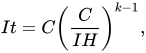


As an example, take a Group 35 battery from a leading manufacturer that rates it at 44 Ah at a 20-hour rate (C20). From this, the rated current is 44 ÷ 20 = 2.2 A — far too low for a car with all electrical loads running. Now Peukert's Law comes into play: assume the reserve capacity is 90 minutes at a 25 A discharge. Entering that into the calculator above gives a Peukert exponent of 1.07. Now assume a 50 A discharge rate and run the numbers through the equation — you get an effective capacity of about 35 Ah. In practical terms, the batteries you see in stores don't really deliver the capacity they appear to once you account for real-world loads. In this example, a leading AGM rated at 44 Ah ends up at about 35 Ah, while a Group 35 from Arc-Angel isn't affected as much and stays around 40 Ah.
Charging Information: Lithium iron phosphate batteries work fine with a vehicle's alternator, which generally outputs around 14.4–14.6 V — within the acceptable charging range. For a top-off charge when the vehicle isn't in use, we recommend a charger built for LiFePO4 batteries with a constant-voltage/constant-current algorithm. A lead-acid charger can also be used, but there are a few things to watch for — see our FAQs for more information.
That's just the overly technical engineer in me. The most important thing to know is this: these batteries are the best of the three on Cold Cranking Amps (CCA), Reserve Capacity (RC), and Capacity (Ah). When comparing batteries, lithium is clearly the superior technology — Arc-Angel LiFePO4 batteries stand tall above the rest on performance. What more could you ask for in a battery? For racing applications, the choice is clear: the Arc-Angel Lithium Battery.
As a quick side note, it's a universal fact across all battery chemistries that a maintenance charger helps extend life. If you purchase one of our batteries, we recommend a charger made for LiFePO4 to fully maximize its life — though other charger types can be used (see our FAQs). Also note that in cold climates, where temperatures stay below freezing for long periods, battery life can be reduced; a battery blanket heater can help combat this and extend life.